

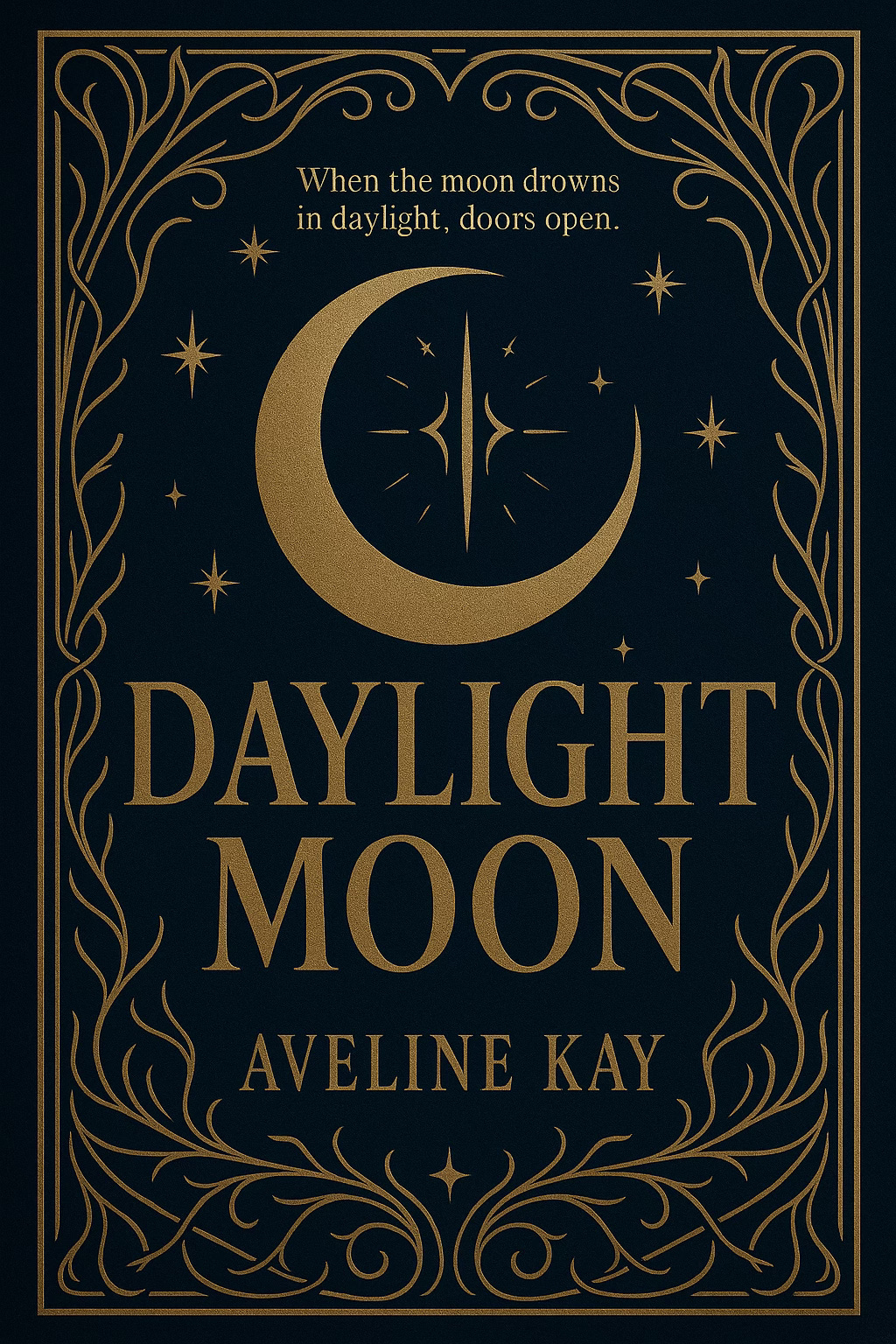
Daylight Moon Chapter One

A few months ago I posted a small snippet of writing that I did when I was a kid. So many of you liked it so I decided to start working on the story again. Here is Chapter One of my rewrite. Would love the feedback.
The gravel path crunches beneath our feet, a quiet rhythm against the soft hum of the park. Spring sunlight filters through the trees, the first real warmth the city has offered in weeks, and it loosens the knot between my shoulder blades. The air smells like damp earth, cut grass, and something sweet I can’t place. A bus exhales at the street beyond the gates; somewhere closer, a kid shrieks from the playground and then laughs like nothing bad can happen on a day like this.
After too many twelve-hour shifts beneath fluorescent lights and the steady hiss of the steamer wand, the sun feels like a hand at my back. I tilt my face into it. My skin drinks it in, greedy for anything that isn’t stale coffee and recycled air.
I’ve worked at Harbor Street Coffee for almost four years, long enough to know exactly which customers tip, which ones ask for extra foam after you’ve already handed them their drink, and which ones treat baristas like background noise. Every year the place gets busier—new apartments, new offices, new people who need caffeine to survive, but somehow we get less staff. My boss, Mr. Aldrin, technically runs the place, but he’s more myth than man at this point. He pops in once every few weeks, mumbles something about numbers, and disappears again like he’s allergic to his own business.
I didn’t plan for this to be my life. I actually went to school for something practical, or at least I convinced myself it was. Four years earning a degree in Literature Studies, fully expecting to become some kind of cardigan-wearing editor in a charming publishing house. Instead, I landed an internship where the lights flickered like a horror movie and I spent my days reading manuscripts that made me question whether humanity deserved books at all. After slogging through one too many epic fantasies with twelve maps and no plot, I realized the only part I truly liked was imagining myself liking it. So I bailed.
And now I live in the city with my best friend, Marin, working a job that pays the rent and nothing more. I use to spend more time with dad. Lately, those days feel fewer and further between, like he’s slipping into the cracks of my schedule.
But for now, there’s sunlight on my face, and it’s the closest thing to peace I’ve felt all week. Dad passes me a coffee, steam curling into the cool air.
“See?” he says with a grin. “A little fresh air never hurt anyone.”
I smile into the rim of the cup. “You said that last time—right before I broke my arm on the monkey bars.”He chuckles, eyes crinkling. “You were fearless back then.”
“I was six.”
“Exactly.” He nudges me with his elbow. “You could use a little of that again.”
“Fearless doesn’t pay the rent,” I say, but it comes out softer than I intend. The guilt’s been sitting on my tongue since I texted him this morning: Today? Finally? Like I’m trying to buy back something I let slip for far too long.
He glances sideways at me now. “Still at the coffee shop?”
“Yeah. It’s been… a lot lately.” I tuck a strand of hair behind my ear. “We’re short-staffed again. New manager loves scheduling doubles like he’s punishing the espresso machine. By the time I get home, I can’t even stand the smell on my clothes “You always did take on too much.”
“Someone’s got to keep the lights on.” I shrug, the gesture small. “Besides, busy keeps me out of my own head.”
He doesn’t argue. He just watches the pond as we pass it, sunlight shattering into small gold coins across the surface. For a second, the reflection is so bright it almost looks wrong, too sharp, like the light is cutting rather than shining. I blink and it’s just water again.
“You haven’t been by in a while,” he says.
“I know.” The words feel heavier than they should. “I meant to. Things got away from me. Work. Bills. Marin’s schedule…”
“How’s Marin?”
“Good. Stubborn. You know her.” I can’t help the faint smile. “She sent me a photo of her breakfast this morning because she thinks I forget to eat when I’m stressed.”
“She’s probably right.” Dad’s mouth twitches. “You were always terrible at taking care of yourself.”
“Not true,” I protest lightly. “I’m here, aren’t I?”
“Yeah.” His voice gentles. “You’re here.”
Something in the way he says it tugs at my chest, like there’s more sitting behind the words. I push the feeling away, the way I always do when something starts to ache.
Because he’s all I’ve really had. After Mom died, it was just the two of us, him working long shifts at the station, me waiting up on the couch because the house felt too big without her. He tried so hard to be everything at once: the steady one, the soft one, the one who packed lunches and remembered picture day and learned how to braid hair badly but proudly. And even now, even with the distance I let creep in, he still shows up for me in every way that matters.
We fall into an easy rhythm. The park is busy in that city way, people everywhere but no one really colliding. A guy strums a guitar by the fountain. A woman walks briskly, heels ticking against the path. Two teenagers skate past us and leave a smear of laughter behind. The trees are on the edge of leafing out, green just teasing the tips.
It’s been months since we had time like this. No to-do lists, no half-finished conversations across a sink of dishes, no checking the time to make sure I’m on time for the night shift. Just us. Just this narrow strip of path between one obligation and the next, pretending it’s its own little world.
“Remember when you used to drag me here every weekend?” he asks. “You’d feed the ducks and give them all names.”
I laugh under my breath. “I was convinced they were the same ones every time.”
“They were, to you.” He takes a thoughtful sip of coffee. “What did you call that round one?”
“Greg.” I lift a shoulder. “Greg had personality.”
“Greg had no sense of moderation.” He smiles, and it lands lightly in my chest, settling in with all the other stupid, ordinary memories I didn’t realize I was hoarding. We walk a few more paces. “You seem different lately. Quieter.”
“I guess I’ve just been thinking a lot.”
“About what?”
“Everything. How fast it’s all moving. How… loud it gets, even when it’s quiet.” I wince at myself; it sounds like something I’d write down and then delete.
He nods, like he understands anyway. “You don’t have to outrun the quiet,” he says. “You can let it catch you.”
“You and your fortune cookie wisdom.”
“Some of the cookies are right.”
We share a small smile. The path curves, and for a moment the trees open to a wide green that makes the city feel generous. Sunlight pours over the grass in long, bright rectangles, striping the ground like doors laid flat.
My smart watch buzzes against my wrist. The spell breaks, snapping the quiet open like a dropped glass. I reach into the pocket to grab my phone, pat around, fingers brushing lining, loose receipts, nothing useful. After a bit of rummaging, my stomach dips as the realization hits.
“Oh, crap,” I mutter, checking the other pocket just in case. “I left my phone in the car in my bag.”
I picture it exactly where I put it, front pocket of my bag, which is on the passenger seat, strap tangled, half-zipped, my whole life stuffed inside: wallet, keys, the book I keep meaning to finish, the coffee shop schedule I’m pretending not to dread. Of course I’d forget it. My brain’s been a messy drawer lately, everything jammed in the wrong place.
Dad smirks. “You and that thing are inseparable.”
“Five minutes,” I promise, stepping backward. “Don’t move.”
He lifts his coffee in salute. “I’ll be right here.”
I jog toward the street, past a cluster of strollers and two men arguing playfully over a picnic blanket, past the woman with the heels and the guitarist tuning his strings. The sun turns the edges of things bright, the rim of a bicycle wheel, the chrome of a bench, the fine hairs on my forearm lit like thread. My breath fogs once in the cooler air of the shade and then disappears when I break back into light.
By the time I reach the curb, something tightens in my chest. Not the run. Something else. A thread pulling taut in a room I can’t see. It’s the same wrong-note feeling I get sometimes waking up, like I’ve stepped out of a dream too fast and left the door open behind me.
The car waits beneath a plane tree, its windshield throwing the sun back at me. I open the back door and duck in for my bag, crack my head on the roof, and hiss through my teeth. “Damn it.” I rub the spot and then laugh once at myself for being so tired and clumsy. I’m always in a hurry. The bag strap catches on the seat buckle; I tug it free.
When I straighten and turn toward the park, the sound goes thin.
It’s like someone has put a hand over the city’s mouth. The bus on the street is a picture moving, but without presence. The guitar near the fountain is the only motion. Even the wind seems to forget how to touch my skin.
The hairs on my arms rise. I take a step forward, then another, my bag suddenly heavy against my shoulder. “Dad?” I call, louder than I mean to, because the air swallows my voice.
There’s a figure on the path where he stood.
Wearing all black. Their hood is up and their face is masked. The figure isn’t bulky, it’s more like a shadow gathered itself and decided on a human shape. My brain takes a beat too long to understand what I’m seeing. A flick of metal, a sharp, precise motion. My father folding at the middle as if his body forgot which way to hold itself.
“Dad?” The word tears out of me. My feet are already moving.
The figure turns, only a pivot, nothing dramatic, and the blank face glances past me as though calculating lines on a map. For one heartbeat, it feels like its attention brushes over me in a cold, measuring way and my skin crawls. Then the shadow figure runs. Across the grass. Between the trees. It’s fast, but practiced. In seconds it’s a smear of dark where the shadows deepen, and then there’s only the dapple of leaves and my breath punching in my throat.
I drop my bag. The gravel burns under my shoes as I sprint. By the time I reach him, he’s on his knees. His coffee cup lies crushed beside him, the liquid spreading and catching the light like spilled gold.
“Dad!” I drop hard, rocks biting into my knees, and press both hands to his abdomen. Heat and wet touch my hands. The slide of blood between my fingers. “Dad, please—look at me.”
His eyes find mine. Glassy and fading, but still present, and for a second it’s like he is holding himself open for me. His fingers flutter, searching for my wrist, and land. His mouth shapes words he doesn’t have breath for, then pulls them up anyway.
“Tell them…” The whisper is thin, carried more by will than air. “When the moon drowns in daylight… you’ll find the door.”
The words slither under my skin, strange and heavy, like I’ve heard them before in a dream I can’t pull into focus.
“What?” I bend closer, my hands shaking against him. “Dad, what door? What are you talking about?”
His lashes tremble. His grip loosens. The weight in my hands shifts, too light, and the breath that was barely there a moment ago is gone. His chest stills.
“Dad?” My voice snaps, brittle. “Dad!”
The cry rips out of me and seems to travel further than sound should, like it’s looking for something to fasten itself to. I press harder, counting without counting, willing anything, any twitch, any startle of air, to prove that the world hasn’t just split along a line I can’t see.
Light gathers under my palms.
It isn’t a glow at first, more like the air simply refuses to hold any shadow. Light gathers sharply, unnaturally, as if the sun has been condensed into a single point. For a heartbeat the world feels double-exposed, grass and brightness and something red overlapping in the wrong places, and then everything beneath my hands is simply… gone.
I slam forward onto my palms. Cold grass meeting my hands. The earth feeling damp. No body. No blood. No warmth slicking my fingers. The imprint of my knees remains in the flattened green, but the weight I was holding is gone as if it had been an idea.
I scramble backward on hands and heels, my gaze scanning for anything that makes sense. “What the—” The word dies, too small for the hole it’s trying to fill.
The world resumes.
A golden retriever barrels past with a tennis ball, tail high. The guitarist at the fountain tests a chord. A woman scrolls her phone, one earbud out. A boy skims by on a scooter, humming to himself. The city hum comes back in like someone unmuted a channel and forgot to warn me first.
“Did you—did anyone see that?” My voice cracks on the new air. “He was just—he was right here!”
People look. A man frowns, confused. The woman with the phone pulls out her other earbud, stares, puts it back in. A teenager glances from me to the empty space and then away, like if he doesn’t make eye contact the weird thing won’t touch him. Their faces settle into the expression strangers wear for other people’s problems, blank, polite, at a distance.
“No.” I push to my feet and sway. The crushed coffee cup glints at my toes. “Please, listen—my dad—he—” I point at the grass as if the ground itself will testify. “He was here. He was attacked.”
The words sound thin, ridiculous, even to me. My heartbeat is too loud. My hands won’t stop shaking. The air smells like grass and sunscreen and fresh-cut oranges from a cart near the gate, and all of it is suddenly unbearable.
A jogger slows. “Miss? Are you okay?”
“I’m not—no—I’m not okay.” I swallow hard and try to breathe through it. “My dad was stabbed. He was right here.”
The jogger scans the empty grass. “I… don’t see anyone.”
“Because he’s gone!” The pitch of my voice is louder this time more frantic. “He was here and then he—he just disappeared.” I hear how that sounds. I can’t make it sound different. “Please.”
Two parents by the swings stop pushing. An older couple on a bench turns their heads together. A man with a dog pauses, his hand tightening on the leash. Whispering scrapes at the edge of my hearing, small and sharp.
“Someone call the police,” a woman says, not unkindly but worried. The words land like a box closing.
“Wait—don’t—please.” I take a step toward her, then stop when she flinches. “He needs help. I need—” I look down. My palms are clean. They shouldn’t be. “He said something—about a door.” My voice drops. “I don’t understand.”
Sirens bloom at the edge of the city’s noise and grow closer, twisting through the streets until they bleed into the park. I stand still because I don’t know what else to do. I stand with my hands open and my knees aching and the sun too bright on the water where ducks drift like nothing has rearranged itself.
Two officers step out of the cruiser, one older, with the steady, measured movements of someone who’s seen too much, and one younger, eyes wide and unsure, the badge still shining like it’s brand new. Relief slams into me, sharp and dizzying, and my knees nearly give. For a second, just seeing the uniform feels like a lifeline.
“Ma’am?” the older one says, careful, palm resting near his belt. “You the one who called this in?”
“No, but—thank God—listen.” Words tumble. I point to the grass, to the cup, to the air itself. “My dad was right here. Someone in a black hood and mask,
came up behind him. I saw it. There was blood and then there wasn’t. He said something before he—before he vanished.”
They exchange a look. Not skepticism yet, but close to its cousin.
“You said he was attacked?” the older one asks.
“Yes!” My breath hitches. “There was blood on my hands and my shirt and now there’s…” Nothing. There is nothing. I look down again as if the evidence might just choose to reappear out of pity.
The younger officer scans the ground. “There’s no blood here, ma’am. No sign of a struggle.”
“Because it’s gone.” The words sound wild. “I don’t know how—it just—” My throat closes. I try again. “Please. Help me find him.”
The older officer steps closer, voice low and even, like he’s guiding a skittish animal. “Alright. Let’s sit you down. We’ll get you some water.”
“I don’t need water, I need my dad.” I flinch when his hand lifts toward my arm. “Why aren’t you listening?”
The radio on his shoulder crackles, a voice I can’t parse. He sighs into it. “Dispatch, this is going to be a psych eval. Will transport.”
“No.” Panic spikes, a clean white stab. “No, I’m not—I’m not crazy. He was here. He’s gone.”
They move fast after that, too fast for the part of me that can’t catch up. One takes my wrist and I pull back; the other lifts a palm and tells me to breathe, and I can’t. Someone nearby raises a phone to record because that’s what people do now, collect moments like they’re souvenirs.
“Let me go,” I gasp, twisting. “You don’t understand—he’s out there—you’re wasting time—”
“Ma’am, calm down,” the younger one says, voice firming. “We’re taking you to the hospital to get checked out.”
“I don’t—please—” The world blurs at the edges. The cruiser door opens and I’m pushed in, the door slamming shut behind me. The city shrinks to the rectangle of the window and my reflection, wide-eyed, mascara running down my cheeks, wrecked, not someone I recognize.
The ride is short and too long. The siren is off. The officer in the front talks into his radio about nothing that matters to me. I try to slow my breathing and fail. Every time I close my eyes I see that impossible light underneath my hands.
I’m escorted into the emergency room, flanked by both officers. Like they’re afraid I’ll run for it if they leave my side. They hand me to an ER nurse like I’m a problem to solve. “Found in the park,” the older officer says quietly. “Hysterical. Reports a murder. No evidence at the scene. Possible hallucinations.”
The nurse nods, professional sympathy settling on her face like a mask. “We’ll take it from here.”
They lead me down a bright corridor into a small room with four white walls and a bed bolted to the floor. A security guard leans against the door frame, neither in nor out. The room smells like antiseptic and air-conditioning.
“Can I call someone?” My voice scrapes. “Please. My dad—he needs help.”
“Let’s get you settled first,” the nurse says gently. She takes my bag and sets it on a chair I’m not sure I’m allowed to sit in. “We just want to make sure you’re safe.”
The word makes my skin crawl. Safe from what.
When she leaves, the silence in the room feels colder than the park’s. I pace. I try the door. It opens two inches before the guard’s hand appears to close it with soft finality. “Best to wait for the doctor,” he says, not unkindly.
Time loosens and then gathers in strange clumps. My hands shake and then go still. My throat burns from crying and makes me realize I’ve finally stopped. A cart squeaks past in the hall. A woman somewhere down the hall cries in hiccups. Footsteps. The distant, constant beeping of machines measuring things that don’t help me. Eventually a doctor comes in with a clipboard and an expression well-practiced into calm. He introduces himself. His name slides off my mind.
“Rachel,” he says, “we think you may have experienced an episode of acute psychosis. Possibly stress-induced. We’d like to keep you for observation tonight and start something that can help you rest.”
“I’m not psychotic,” I say, too fast. “My dad was murdered. He was there. I held him.”
I almost say, I watched him disappear, but even in this room, the words feel too sharp to put in the air.
He nods in a way that means I hear the words if not the reality of them. “We’ll talk more in the morning.”
When he leaves, I sit on the bed and stare at my hands. The lines in my palms mean nothing. My knuckles are clean. The scrubbed smell of the room creeps into my throat. A phantom slickness lingers on my skin, memory of warmth that isn’t there.
I stand. I can’t not move. The phone on the wall looks like a lifeline and then like a prop. I lift it anyway and dial my dad’s number. It goes straight to voicemail. I call again. Voicemail.
I swallow and dial another number. Marin picks up on the third ring, groggy. “Rach? It’s late. Are you—why are you calling from a hospital?”
“Marin.” Relief hits so hard my knees nearly give. “Listen, I need—I need you to come. My dad—he’s missing. He was stabbed in the park. I saw it.”
Silence. Then, cautious, gentle: “Rachel… your dad’s been gone for years.”
I freeze. “What?”
“You know that,” she says softly. “We’ve talked about it.” A breath. “Stay put, okay? I’m coming. Just—stay.”
My grip tightens on the receiver. The hallway hums. The room tilts a fraction. “No,” I whisper, the word tearing at my throat. “No, that’s not—he was just with me. Yesterday. He was there.”
“Rach.” Her voice is a hand I can’t feel. “I’m on my way.”
I hang up. The phone lands in the cradle harder than I mean it to. The sound seems too loud for such a small room.
“Dammit,” I breathe, fingers in my hair. The world is too bright and too distant at the same time.
I slide down the wall until I’m sitting on the cold floor, knees to my chest. The fluorescent light hums like something alive. I press my palms over my eyes until colors pulse behind them. My breath skitters.
For the first time since the park, a thought I’ve been refusing edges in and sits down across from me.
Maybe they’re right. Maybe I am losing my mind.
Your opening chapter pulls the reader in with a quiet intensity. The atmosphere feels lived in, almost breathing, and the emotional undercurrent is strong without ever being forced. You have that rare ability to build a world through small details and rhythm instead of exposition. It makes the scene feel intimate from the first lines.
There is a tenderness here, even inside the tension. A sense that something is shifting beneath the surface and the character can feel it before they can name it. That kind of writing stays with people.
A beautiful start. It sets the stage for a story that is going to unfold in a very human, very compelling way.